 Bildon Steel
Bildon Steel
Bildon Steel
Estimating a steel building in China requires more than multiplying steel weight by a market price. The practical question is how to calculate steel structure building cost per square meter without hiding important variables. A useful starting formula is: total project cost divided by gross floor area. Total cost should include steel frames, cladding, connections, foundations, transport, installation, fire protection, design, taxes, and project management.
Recent industry reports show why this calculation must remain flexible. The World Steel Association’s Short Range Outlook reported global steel demand near 1.75 billion tonnes in 2024, while Chinese demand faced continued pressure from the property sector. Turner & Townsend’s International Construction Market Survey also identifies labor, materials, logistics, and financing as major construction-cost influences. These reports do not provide one universal China price. They provide context for better judgment.
Edwin Basson, Director General of worldsteel, has stated, “Steel is fundamental to modern life.” That principle matters here. A low quotation may use thinner members, exclude foundations, or calculate only the warehouse shell. A stronger estimate separates material quantity from procurement cost. It checks whether the price includes VAT, delivery distance, erection equipment, and local labor conditions.
Small details matter.
For example, a 5,000-square-meter factory near Shanghai may face different transport and labor costs than one near Chengdu. Exchange-rate changes can also affect imported equipment. The formula is helpful, but it is not perfect. A spreadsheet can still lie when its assumptions are weak. This guide explains each cost layer, compares realistic calculation methods, and highlights the questions buyers should ask before accepting a per-square-meter quotation.
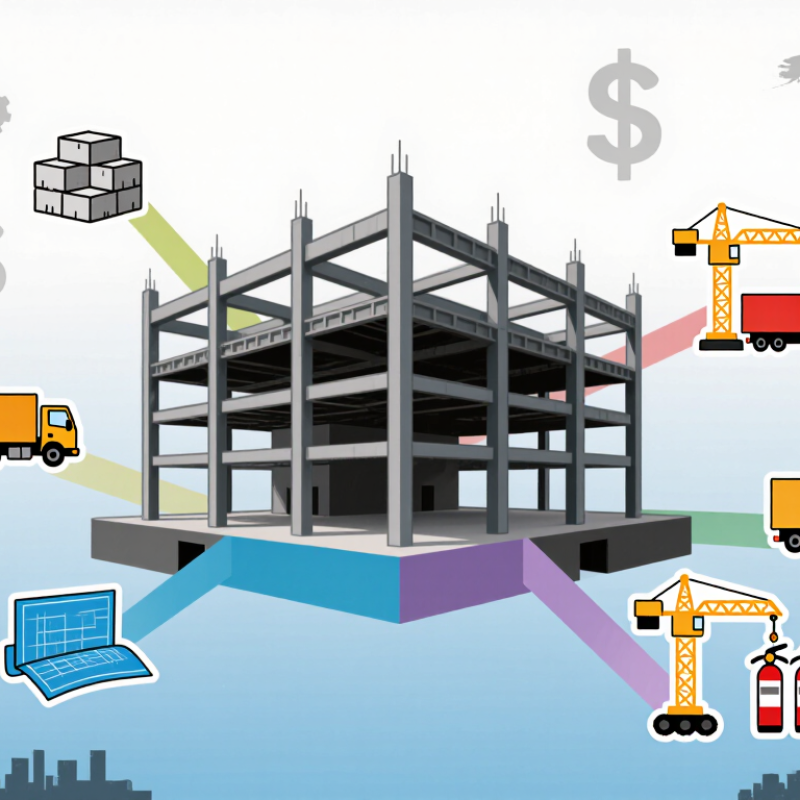
Before asking for a China steel building cost per square meter, define the building precisely. State the length, width, eave height, roof slope, column spacing, and clear internal height. Add the building use, such as a warehouse, workshop, or agricultural facility. A 6-meter eave height is not priced like a 10-meter production hall.
Specify the structural system and loading conditions. Include local wind speed, snow load, seismic intensity, crane capacity, fire rating, insulation thickness, and cladding type. For example, a 10-ton overhead crane needs stronger columns, rails, foundations, and connections. World Steel Association’s World Steel in Figures 2024 recorded about 1.892 billion tonnes of crude steel production in 2023. This scale does not guarantee a fixed quotation. Steel grades, fabrication quality, and delivery timing still change the final rate.
The scope must also identify excluded work. Clarify whether the price covers engineering, anchors, foundations, doors, windows, drainage, electrical systems, installation, and transport. China’s National Bureau of Statistics reported construction industry output of roughly CNY 31.6 trillion in 2023, showing the market’s large scale but not project-level uniformity. A low initial estimate may omit essential items. I have seen this mistake repeatedly. Recheck every assumption before dividing the total budget by floor area.
| Scope Item | Typical Specification for Budgeting | Unit or Quantity Basis | Indicative Cost Range | Cost Inclusion |
|---|---|---|---|---|
| Building Area | Single-story industrial building with a rectangular footprint | 1,000 m² example project | Calculation basis | Total project cost is divided by the gross floor area. |
| Clear Height | 6–8 m clear internal height | Per building design | Included in base range | Greater height increases steel tonnage, wall area, and installation effort. |
| Structural Steel Frame | Welded portal frames using standard structural steel sections; approximately 35–60 kg of primary steel per m² | Per m² of floor area | RMB 450–800/m² USD 63–111/m² |
Columns, rafters, connection plates, welding, shop fabrication, and surface preparation. |
| Secondary Steel | Cold-formed purlins, girts, bracing, eave struts, and connection accessories | Per m² of floor area | RMB 100–180/m² USD 14–25/m² |
Supports the roof and wall cladding and stabilizes the main frame. |
| Roof System | Insulated metal roof panels with approximately 75–100 mm insulation, gutters, and flashings | Per m² of roof area | RMB 120–220/m² USD 17–31/m² |
Roof sheets or panels, insulation, waterproofing details, drainage, and installation. |
| Wall Cladding | Insulated sandwich panels or profiled metal sheets with approximately 50–75 mm insulation | Per m² of wall area | RMB 150–320/m² USD 21–44/m² |
External wall panels, trims, corner details, insulation, and fixing systems. |
| Doors, Windows, and Openings | One industrial sliding or rolling door, personnel doors, and limited aluminum or steel windows | Per m² of floor area | RMB 60–180/m² USD 8–25/m² |
Openings, frames, hardware, weather seals, and installation. |
| Concrete Foundations and Floor | Reinforced concrete pad foundations, anchor bolts, and 150–200 mm industrial floor slab | Per m² of floor area | RMB 250–500/m² USD 35–69/m² |
Excavation, reinforcement, concrete, formwork, foundations, and basic floor finishing. |
| Electrical and Mechanical Services | Basic lighting, distribution boards, ventilation, water supply, drainage, and low-capacity equipment connections | Per m² of floor area | RMB 250–700/m² USD 35–97/m² |
Basic building services only; production machinery and specialized systems are excluded. |
| Fire Protection | Fire extinguishers, emergency lighting, alarm points, and basic fire-water provisions | Per m² of floor area | RMB 50–150/m² USD 7–21/m² |
Final requirements depend on occupancy, fire rating, building area, and local approval rules. |
| Overhead Crane Provision | Optional 5–10 tonne crane runway beams and supporting columns | Per m² of floor area, if required | Add RMB 150–450/m² USD 21–63/m² |
Additional steel, runway beams, brackets, and crane-related structural reinforcement. |
| Site Works and External Services | Basic access paving, stormwater connection, utility trenching, and site preparation | Per m² of floor area | RMB 100–350/m² USD 14–49/m² |
Varies significantly with soil conditions, site distance, drainage, and utility availability. |
| Steel Shell Budget | Main frame, secondary steel, roof system, wall cladding, standard openings, and installation | Per m² of floor area | RMB 820–1,700/m² USD 114–236/m² |
Usually excludes foundations, MEP services, fire systems, machinery, and land-related costs. |
| Complete Building Budget | Steel shell, concrete foundations and floor, basic electrical and mechanical services, and fire protection | Per m² of floor area | RMB 1,500–3,050/m² USD 208–424/m² |
A practical preliminary range for a standard industrial steel building in mainland China. |
| Example Calculation | 1,000 m² building multiplied by an assumed complete-building rate of RMB 2,100/m² | 1,000 m² × RMB 2,100/m² | RMB 2,100,000 Approximately USD 291,700 |
Illustrative calculation before taxes, land costs, design fees, financing, and unusual site conditions. |
| Budgeting note: The ranges are indicative 2025–2026 planning figures for standard industrial steel buildings in mainland China. They are not a quotation and may change with steel market prices, project location, seismic design, snow and wind loads, soil conditions, labor rates, building height, crane requirements, fire rating, insulation performance, taxes, transportation distance, and the selected finish level. USD values use an indicative exchange rate of RMB 7.20 per USD. | ||||
Include steel, fabrication, foundations, cladding, installation, transport, labor, equipment, and project management. Add taxes and inspections separately.
Divide the total estimated budget by the building’s gross floor area. Use gross area, not steel tonnage alone.
A working model may include 2,400 RMB for construction, 450 RMB for installation, and 200 RMB for management. The subtotal is 3,050 RMB per square meter.
A five percent contingency raises 3,050 RMB to about 3,203 RMB per square meter. This remains an estimate, not a tender price.
At 60 kilograms per square meter, the workshop may require about 60 tonnes of structural steel. The actual quantity needs engineering confirmation.
Remote sites may add delivery and crane charges. Coastal locations may require stronger corrosion protection. Urban sites may need extra traffic controls and fire systems.
Mezzanine offices, wide clear spans, heavy snow, strong winds, and seismic loads can increase steel and foundation requirements.
Record steel grade, coating thickness, insulation value, fire rating, transport limits, and installation responsibilities. Otherwise, comparisons can mislead.
Request a dated quotation because material markets change. A six-month-old price may need revision.
Foundations often contain the weakest allowance. Soil conditions, building reactions, and access constraints can change the budget quickly.
Estimating the cost of a steel building in China begins with clearly defining the project scope and specifications. Identify the building’s size, purpose, number of floors, structural system, required materials, insulation, doors, windows, roofing, and interior finishes. These details establish the quantities and performance standards needed for an accurate estimate. To understand how to calculate steel structure building cost per square meter, divide the total projected expense by the building’s gross floor area after calculating each major cost category.
The estimate should include steel and other material costs, design and engineering, fabrication, surface treatment, packaging, transportation, construction, equipment, installation, and project management. Allowances for foundations, utilities, permits, and site preparation may also be necessary. Finally, adjust the budget according to the project’s location, transportation distance, design complexity, construction conditions, labor rates, currency changes, and current market prices. A clear cost breakdown with reasonable contingencies will make the estimate more practical and easier to update.
