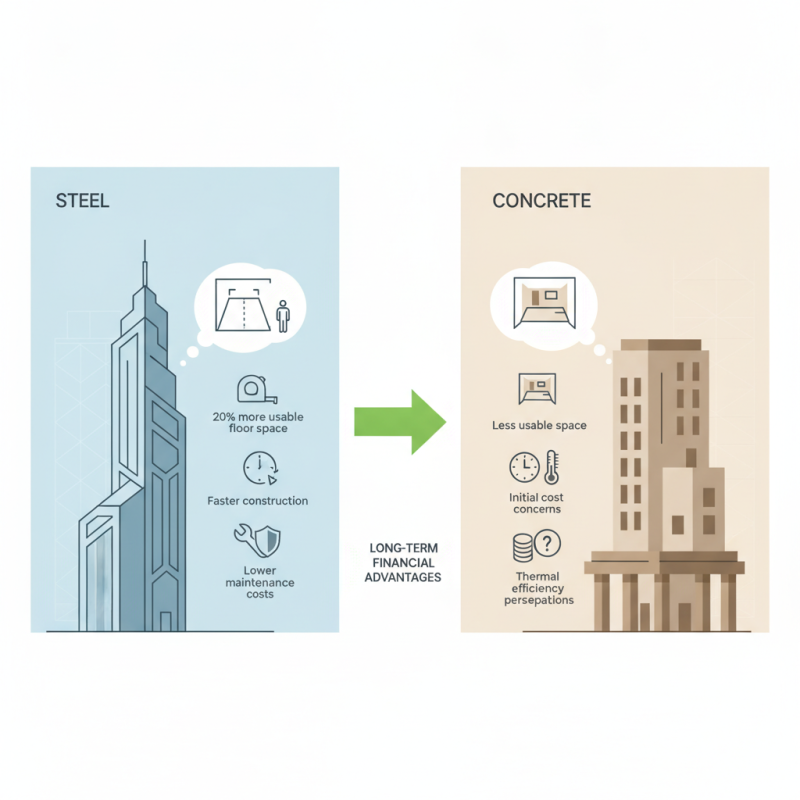
In the realm of commercial construction, the debate over "why choose steel structure over concrete for commercial buildings" remains prominent. According to the Steel Construction Institute, steel buildings can provide up to 20% more usable floor space compared to traditional concrete structures. This is due to the greater flexibility in design and the ability to create larger spans with less material.
Expert Frank Johnson, a structural engineer with over 20 years of experience, emphasizes, “Steel allows for innovative designs and faster construction times.” His insights highlight the practical advantages of steel, particularly in urban environments where space is a premium. Furthermore, the durability of steel structures often leads to lower maintenance costs over time.
Despite the benefits, some hesitate to fully embrace steel. Concerns about initial costs and perceptions of thermal efficiency can deter decisions. However, studies show the long-term financial advantages outweigh these initial investments, making steel a wise choice for commercial projects. This ongoing discussion continues to shape the future of building design and construction.
Advantages of Steel Structures in Commercial Building Design
Steel structures offer numerous advantages in commercial building design. They provide a high strength-to-weight ratio, allowing for larger open spaces than concrete. This flexibility is ideal for offices and retail spaces where room layout can significantly affect the flow of people and goods. Steel's durability also means lower maintenance costs over time, making it a smart choice for long-term investments.
One notable aspect of steel construction is speed. Steel components can be fabricated off-site and quickly assembled on location. This reduces construction time, minimizing disruptions for businesses. However, it’s important to consider site-specific factors, such as environmental impact and local regulations. While steel is often more cost-effective, initial costs can be higher than concrete in some situations. It's essential to evaluate these factors for each project.
Moreover, steel's recyclability supports sustainable practices. Many structures today aim for green certifications, and using steel can help. Yet, the production process can be energy-intensive. Balancing sustainability with practical needs remains a challenge in design. Hence, every project requires careful consideration of both materials and purpose.
Why Choose Steel Structure Over Concrete for Commercial Buildings?
| Advantage |
Steel Structures |
Concrete Structures |
| Weight |
Lighter, reducing foundation costs |
Heavier, requiring stronger foundations |
| Construction Speed |
Faster erection due to prefabrication |
Longer construction time |
| Flexibility |
Easily adaptable for reconfiguration |
Difficult to modify post-construction |
| Durability |
Resistant to rust when treated |
Prone to cracking and spalling |
| Maintenance |
Lower long-term maintenance |
Requires regular upkeep to prevent damage |
Cost-Effectiveness Analysis: Steel vs. Concrete
When comparing steel and concrete for commercial buildings, cost-effectiveness plays a vital role. According to the American Institute of Steel Construction, steel structures often lead to a lower overall project cost. This is primarily due to reduced labor costs and shorter construction times. Steel allows for quicker assembly, which can significantly cut down on labor expenses. In contrast, concrete may require longer curing times and extensive scaffolding, delaying the overall project timeline.
In a recent study by the Steel Construction Institute, it was found that the total lifecycle cost of steel buildings can be up to 10% lower than their concrete counterparts. This analysis considered not only initial construction expenses but also maintenance and repair needs over time. Steel structures generally require less maintenance due to their resilience against weather elements. Moreover, the recyclability of steel adds to its long-term cost-effectiveness and sustainability.
However, it’s crucial to discuss potential drawbacks. Steel may have higher initial material costs compared to concrete. Additionally, while steel is lighter, it does necessitate more careful design considerations to ensure structural integrity. These factors can introduce complexity in the planning phase. Balancing these elements is essential for effective project management.
Durability and Maintenance Considerations for Steel Structures
Steel structures offer significant durability advantages over concrete in commercial buildings. They are resistant to many environmental factors, which often lead to reduced maintenance costs. For instance, steel does not warp or crack like concrete, especially in extreme weather. This resilience allows for extended lifespans, making steel a cost-effective choice over time.
Maintenance considerations also favor steel. While concrete often requires sealing and can suffer from rust stains, steel can be treated with protective coatings. These coatings can prevent corrosion and extend the life of the structure. However, applying these coatings requires expertise, and improper application can lead to complications. Therefore, choosing a qualified contractor is crucial.
Despite these advantages, it's essential to acknowledge the challenges. Steel structures can be susceptible to fire if not properly treated. This necessity for fire-resistant measures adds a layer of planning and expense. Each project's unique needs must be carefully evaluated to ensure the best outcome. Thus, while steel presents clear advantages in durability and maintenance, the decision must align with specific project requirements and local conditions.
Durability and Maintenance Comparison: Steel vs Concrete Structures
Environmental Impact: Steel Structures vs. Concrete
The environmental impact of building materials is increasingly important in construction.
Steel structures have several advantages over concrete. According to industry reports, steel recycling rates exceed 85%. This reduces the demand for raw materials and cuts greenhouse gas emissions. Concrete, in contrast, is responsible for 8% of global CO2 emissions.
Steel's production can be energy-intensive. Yet, its durability and longevity offset initial impacts. A well-constructed steel building can last decades longer than concrete, resulting in lower energy consumption over its lifetime.
However, concrete does have benefits. Its thermal mass can help regulate indoor temperatures, reducing heating and cooling costs.
Land use is another aspect. Steel structures require less foundation material due to their lighter weight. This reduces land disturbance, preserving local ecosystems. Concrete foundations can be massive, impacting the surrounding environment. While both materials have strengths, careful consideration of their ecological footprints is essential for sustainable construction practices.
Construction Speed and Flexibility in Steel Commercial Buildings
Steel structures are gaining popularity in commercial buildings due to their construction speed. A recent report by the American Institute of Steel Construction highlights that steel framing can be erected 30% faster than concrete methods. This speed significantly reduces the overall project timeline, allowing businesses to operate sooner. Rapid construction can lead to earlier returns on investment and lower project financing costs.
Flexibility is another advantage for steel commercial buildings. The lightweight nature of steel permits larger spans without needing intermediate supports. According to industry data, 70% of architects prefer steel for its adaptability. This flexibility allows for modifications during construction, making it easier to meet changing client needs. However, builders must consider the design and engineering requirements to maximize these benefits effectively.
Despite these advantages, reliance on steel brings challenges. Weather conditions can impact steel delivery and assembly. Additionally, labor shortages in skilled trades can slow project progress. While steel provides speed and flexibility, addressing these issues is crucial for maximizing its potential for commercial buildings. Adapting construction processes to unforeseen challenges is a necessary step forward.
FAQS
: Steel structures offer high strength-to-weight ratios, enabling larger open spaces for offices and retail.
Steel framing can be erected 30% faster than concrete methods, reducing project timelines.
Yes, steel recycling rates exceed 85%, significantly lowering raw material demands and CO2 emissions.
Steel's durability results in lower maintenance costs over time and longer lifespans than concrete.
Yes, the lightweight nature of steel allows for flexibility, accommodating changes during construction.
Weather conditions and skilled labor shortages can affect project progress and assembly timelines.
In some cases, yes. Initial costs may be higher, so evaluating project specifics is essential.
Steel structures require less foundation material, reducing land disturbance and preserving ecosystems.
While steel is recyclable, its production is energy-intensive, requiring a balance between sustainability and practicality.
A well-constructed steel building lasts longer, thus reducing overall energy usage over time compared to concrete.
Conclusion
In the debate of building materials for commercial structures, many ask, "why choose steel structure over concrete for commercial buildings?" Steel structures offer several advantages, including superior strength-to-weight ratios, which result in reduced foundation requirements and overall material savings. Cost-effectiveness is a significant factor, with steel often providing a more budget-friendly option when considering both initial costs and long-term maintenance.
Durability is another robust feature of steel, as it resists corrosion and can withstand harsh environmental conditions better than concrete. Additionally, steel construction permits faster build times due to pre-fabrication capabilities and offers greater design flexibility, allowing for innovative and functional commercial spaces. Lastly, when considering environmental impact, steel's recyclability contributes to a more sustainable building approach.
 Bildon Steel
